Knowledge of the difference between VAT and the Corporate Tax has become an important necessity to any business in the UAE. Due to the maturity of the tax regime of the country, businesses are supposed to be well aware of the impact of various taxes on their pricing, profitability and compliance. Through professional advice of Business One Tax and Accounting, UAE companies can plan their operations effectively and comfortably with existing regulations and how to grow sustainably.
Introduction: Decoding Taxes for UAE Companies
The UAE has established itself as a business-friendly country, but with the introduction of VAT in UAE and Corporate Tax in UAE, the financial liabilities of firms have been redefined. These are some of the taxes under a modernized UAE taxation system aimed at acquiring transparency and international adherence. Business One Tax & Accounting assists companies with Professional Accounting Services which make complicated tax systems easy and accurate on the first day.
Understanding the Basics of VAT and Corporate Tax
At the very base, VAT and Corporate Tax do not have the same purposes. VAT is an indirect tax that imposes taxes on goods and services at every point in the supply chain, and thus VAT to businesses is a transactional tax. Corporate Tax on the other hand, entails a direct tax on net profits and defines long term financial plans. Business One Tax and Accounting assist businesses in monitoring their taxes effectively as well as making sure they remain abreast with the law with its quality Bookkeeping Services.
Why UAE Companies Need to Stay Tax-Savvy
Remaining tax-savvy helps businesses to avoid fines, audits and loss of cash flow. Tax compliance will ensure that timely filings are made, reporting done properly and improved financial forecasting is made. Payroll Services, such as salary structures, statutory deductions, and so forth, are critical to compliance, which Business one Tax and accounting provides with the same accuracy and relaxation.
Also Read: Understanding UAE Tax Laws: A Guide for Small Business Owners
VAT in the UAE: A Deep Dive
One of the foundations of the UAE indirect taxation is VAT. It has contributed to the way invoicing is done, pricing, and cash flow management in the industries since its introduction. Business One Tax and Accounting uses special VAT Services to make sure that businesses know how VAT is used with their goods and services and are not caught in the trap of non-compliance.
What is VAT and How Does it Work in the UAE?
What is VAT in UAE? VAT is a consumption tax of 5 percent, which is imposed on a majority of goods and services. Businesses collect VAT on sales to customers and pay to the Federal Tax Authority less input VAT that is eligible to be offset. Right records and proper filings are necessary which are backed by professional Bookkeeping Services to minimize mistakes and provide clarity.
VAT Registration Process for UAE Companies
Once a business exceeds the stipulated turnover, registration of VAT is obligatory. The prompt registration of VAT prevents fines and guarantees continuity of operations. Business One Tax and Accounting facilitate documentation, submissions and follow ups with the help of expert VAT Services.
VAT Rates: What You Need to Know
Although the general VAT is 5 percent, some of the supplies are zero rated or tax-exempt in UAE in VAT exemptions. The awareness of the category that your business belongs to will enable you to charge the most appropriate price and keep the compliance without charging the customers unreasonably.
Who Needs to Charge VAT in the UAE?
A majority of the businesses in the mainland and some free zone entities that provide goods or services subject to taxation have to pay VAT. VAT on small business in UAE might appear as something complex, however, with the help of the correct systems and consultancy services, it becomes simple and easy to comply.
Read more: A Comprehensive Guide to VAT Voluntary Disclosure in the UAE
Common VAT Misconceptions and Myths in UAE Business
- Profit Myth: VAT does not automatically decrease profits as many businesses tend to think. Nevertheless, when VAT is handled properly with good accounting and bookkeeping methods, it has no negative effect on the overall earnings and margins.
- Free Zone: Free zone companies do not necessarily receive VAT exemption. The eligibility varies according to the nature of business operation, clients reached and certain regulatory factors, thus this should be assessed keenly to maintain the required compliance.
- Penalty Risk: There is a threat of huge fines and legal punishment in case of failure to register, misinterpretation of VAT regulations, or wrong filing. Companies should focus more on compliance to prevent financial loss and negative image in UAE.
- Invoice Errors: Inaccurate invoice, omiture of VAT information or miscalculations may initiate audit and battle with government. Good records and accounting of the facts are necessary in the process of running smooth operations, accountability, as well as preventing possible penalties imposed by FTA.
- Refund Confusion: This is because of the many businesses that think VAT refunds are automatic. Refunding claims must be properly documented, invoices must be provided, and compliance regulations followed to get businesses the appropriate amounts of input VAT properly and in time.
- Threshold Limits: It is misguided that some companies think that all businesses should be registered under VAT. As a matter of fact, registration is based on exceeding the set turnover limit, and companies lower than this limit could be left in exemption as long as they do not violate the UAE law.
- Exemption Misunderstanding: Sometimes business will misclassify goods or services as exempt or zero-rated. Proper classification and documentation is vital in order to prevent punishments, correct reporting, and stay within the UAE VAT regulations.
- Expert Advice: The absence of professional advice adds the risk of errors, non-compliance, and punishment. The involvement of tax consultants facilitates business to overcome the complicated VAT regulations, streamline operations, and make proper filing in the UAE.
Important Tips: How to Choose the Best Tax Agent in the UAE: A Complete Guide
Corporate Tax in the UAE: Understanding the Framework
Corporate Tax is a great change in the fiscal scenario in the UAE. It keeps the country up to date with the international standards and at the same time makes it competitive. Business One tax & Accounting assists businesses to adjust with this changing structure with specific Corporate Tax Services.
Corporate Tax Explained: Definition and Purpose
Corporate Tax is a direct tax on net business profits, which is aimed at increasing the sustainability of the economies. It is a mandatory practice in the corporate tax of companies that demand proper financial reporting and strict record keeping with the help of strong Accounting Services.
How Corporate Tax Affects UAE Companies
Corporate Tax has an impact on the investment choices, expansion strategies and profitability. In Corporate Tax on foreign owned business in UAE and Corporate Tax on multinational business in UAE, key to strategy structuring is important. Business One Tax & Accounting makes sure that they comply and also find areas of efficiency.
Corporate Tax Rate and Structure in the UAE
The Corporate Tax rate in the UAE is also very competitive in the world which has maintained its attractiveness to investors. Knowledge of thresholds, deductions, and filing will enable the businesses to engage the tax aspect in the long-term financial plans.
Which Businesses are Subject to Corporate Tax in the UAE?
Most of the mainland businesses and most of the qualifying free zone entities are governed by the Corporate Tax. The e-commerce companies in UAE and digital businesses should not be treated like other corporations because of the recognition of revenue and cross-border transactions. Business One Tax and Accounting offer customized compliance services with the help of professional Corporate Tax Services.
Exemptions and Special Cases for Corporate Tax
Some of these entities can enjoy exemptions and preferential treatment such as certain kinds of free zone businesses that fulfill certain requirements of the regulations. Tax benefits on free zone business UAE needs to have proper filings and continuous compliance which can be facilitated by relying on reliable Payroll Services and Business One Tax and Accounting advisory.
Read in-depth: Why Corporate Tax Deadlines Matter for UAE Businesses
Key Differences Between VAT and Corporate Tax in the UAE
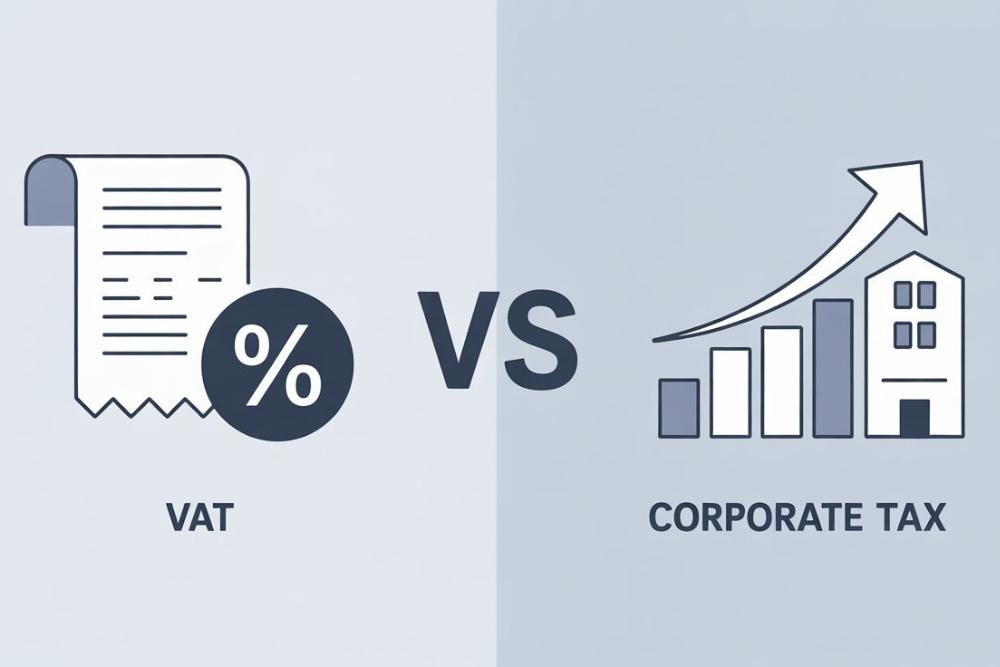
Conceptualizing the differences between VAT and Corporate Tax when dealing with the real world allows UAE business to operate with ease and prevent expensive compliance errors. Although they are both subdivisions of the larger UAE taxation system, their focus, monetary effect and management duties are highly dissimilar.
VAT vs Corporate Tax: Scope of Application
The VAT vs Corporate Tax differences are inherently different. VAT is levied on the provision of goods and services and is transactional in nature whereby it is brought into effect whenever a sale of goods and services that attract tax is made. It affects the normal business activities like invoicing, pricing and collection of cash.
Corporate Tax on the other hand is levied on net profits made in a financial year. It is not associated with single transactions but with the performance of the whole business. This renders Corporate Tax to be more strategic in existence, it affects the long-term planning, cost control and investment decision. It is essential to acknowledge this distinction in order to structure finances and abide by them.
What makes it special:
- VAT is transaction-focused, while Corporate Tax is profit-focused.
- Helps businesses differentiate between operational and strategic taxation.
- Provides clarity on which tax affects which part of the business.
- Encourages proper financial structuring.
- Supports compliance and planning for long-term growth.
How VAT and Corporate Tax Impact Your Business Financials
VAT has a direct impact on the cash flow since companies collect it at the shop floor and subsequently pay it to the government. The inability to manage VAT well may lead to liquidity problems particularly when the input VAT is not properly recorded or when refunds are not received in good time.
Corporate Tax does not affect the time of cash flow but the level of profitability. Costs, depreciation and allowable deductions are significant since it is computed based on the net income. Combined, VAT and Corporate Tax influence the pricing strategies, margins, and the financial health in general, so it is crucial to consider them as a single tax planning.
Why it is helpful:
- Ensures better cash flow management.
- Highlights impact of taxes on profit margins.
- Guides decisions on expenses and deductions.
- Supports pricing and financial planning.
- Reduces the risk of liquidity issues or financial strain.
Filing, Deadlines, and Penalties: What’s the Difference?
The VAT returns are usually filed on a regular basis either monthly or quarterly according to the registration status. Late submission and wrong filing may attract administrative fines and non-compliance penalties on VAT in UAE.
Corporate Tax returns are typically related to the annual period, and are congruent with the financial year. Nevertheless, the fines against the registration later than the stipulated time, the payment later than the stipulated time, or the declaration that is not correct may be substantial. The most important thing is to understand the deadlines of both taxes and the documents needed to keep in order not to spend unnecessary money and financial commitments.
How it eases tax issues:
- Keeps businesses compliant with authorities.
- Reduces risk of fines or penalties.
- Helps organize internal accounting and reporting processes.
- Ensures timely submission and payment of taxes.
- Supports smoother audits and inspections.
The Role of Businesses in VAT vs Corporate Tax Collection
Under VAT, the businesses would serve as tax collectors to the government. They collect and pay the VAT, issue compliant tax invoices, keep records and pay the sum of the amount collected.
In the case of Corporate Tax, the businesses are taxpayers. They compute the taxable income, multiply it by the rate of the Corporate Tax in effect and pay it as such. This is the distinction in responsibility which explains why VAT is operationally oriented whereas corporate tax is financially and strategically oriented.
Why it is necessary:
- Clarifies business responsibilities for each tax.
- Prevents errors in VAT collection or Corporate Tax payment.
- Helps structure accounting and finance operations.
- Ensures regulatory compliance.
- Minimizes risks of audits, penalties, and disputes.
Get insights on: How to Register for Corporate Tax in the UAE: Step-by-Step Guide
VAT and Corporate Tax Compliance: How to Stay on Top
Remaining in compliance with VAT and Corporate Tax cannot be done with very simple accounting but it must be organized and well documented with effective planning. Companies that view compliance as a continuous operation, and not a one-year undertaking are in a position of being successful in the long run.
Building a Solid Tax Strategy for Your UAE Company
A good tax plan represents a fit between business objectives and regulations. This involves the knowledge of VAT requirements, determining Corporate Tax exposure, tax exemptions, and cost planning. Strategic tax planning is able to reduce risks, maximize expenses and maintain compliance without interruption to operations.
Using Digital Tools to Simplify VAT and Corporate Tax Management
Automation is important in modern tax compliance. UAE Business tax software and new accounting systems aid in maintaining records of transactions, computing liabilities, creating reports, and compliant filing. The proper tools decrease human error and enhance the accuracy and give real-time information on the tax positions.
Hiring a Tax Consultant: Is it Worth the Investment?
As the rules become stricter and the question of the validity of tax advice grows, professional counsel is a potentially wise investment. In UAE, qualified tax advisors assist with VAT and Corporate Tax Planning, interpretation, filing, administration of audits and strategic planning. In the case of growing businesses, professional services tend to be cheaper than the cost of not doing so and the risks involved.
Common Mistakes to Avoid in VAT and Corporate Tax Filings
Among the most frequent errors, one can distinguish late registration, wrong tax classifications, improper record keeping, and misconception of exemptions. Personal and business expenses can be mixed, the terms of the free zone can be overlooked, and VAT should not be reconciled regularly, all of which may cause severe compliance problems. The best protection is awareness and proactive management.
The End Note!
To sum up, VAT vs Corporate Tax are a constant fact of business in the UAE. Those firms that are aware of the differences, are diligently compliant and strategic planners will not only escape the punishments but also enjoy financial clarity and confidence. When knowledge, preparation and consistency are involved, tax compliance becomes less of a challenge, more of an advantage.
Frequently Asked Questions